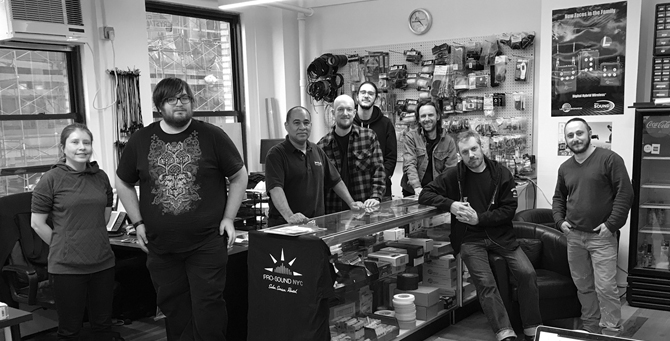
New York
311 West 43rd Street
Suite #1100
New York, NY 10036
212.586.1033
800.883.1033
New Orleans
1515 South Salcedo Street
Suite #130
New Orleans, LA 70125
504.309.7112
855.309.7112
Hablamos espanol
New York
311 West 43rd Street
Suite #1100
New York, NY 10036
212.586.1033
800.883.1033
New Orleans
1515 South Salcedo Street
Suite #130
New Orleans, LA 70125
504.309.7112
855.309.7112
Hablamos espanol
ireless InfoW
FREQUENTLY ASKED QUESTIONS:
Wireless Frequency Guide
Help File (Frequently Asked Questions)
What frequencies are used for Wireless Products in the U.S.?
Wireless systems in the U.S. operate on various unused frequencies within the broadcast television spectrum. VHF systems utilize TV channels 7 through 13 (174 - 216 MHz). UHF systems range across TV channels 35 through 69 (596 - 806 MHz). Obviously, fixed channel systems operate on a single frequency, while frequency-agile systems are selectable across a range of frequencies.
How do TV stations figure into frequency selection?
Wireless systems should NOT be operated on the same frequency as a local TV station. Only open (unoccupied) frequencies should be used. In the U.S., each major city has different local TV stations. The operating frequencies of those stations must be avoided when choosing a wireless system frequency.
I keep hearing that DTV stations are a big problem. Is that true?
Digital television stations (DTV) represent a wireless interference problem just like any other broadcast signal. They are a major source of interference on the frequencies being used and, depending on the city you're in, local DTV stations may be on the same frequencies as your wireless system. Another factor is that any new broadcast station contributes to "frequency crowding". Many DTV stations have been licensed but are not yet on the air.
Will DTV make my wireless system obsolete?
Like everything else with wireless, the answer is simple: it depends on the frequency. Proper planning makes it relatively easy to avoid problems, both now and in the future. With a frequency-agile wireless system, it's a simple matter to avoid local broadcast TV frequencies (both analog and DTV) by simply changing channels. With a single-frequency system, it's more important to choose frequencies known to be clear, both now and in the future.
What is the best way to avoid interference?
Probably the best way to avoid interference is to invest in a "frequency-agile" wireless system. That means the user can change frequencies when interference is encountered. Virtually all touring groups use frequency-agile systems, since their wireless environment changes as they move from town to town.
I'm in a touring band. How do I choose a wireless system?
You are a prime candidate for a "frequency-agile" wireless system. These systems generally cost a little more, but allow you to change frequencies to avoid interference as you move from town to town.
What if I only play in my home town?
In this situation, the TV interference "landscape" is unlikely to change. At Professional Sound Services we will make it a point to sell wireless that is consistently interference-free within the local area. In this situation, a less expensive fixed-frequency wireless system is a viable option.
How do I avoid TV interference?
The only dependable way to avoid TV station interference is to know and avoid the frequency bands occupied by local stations. Familiarize yourself with this Web-based listing of local TV stations in major U.S. markets. Suburbs of these cities may or may not have the same local TV stations as the listed city, depending on distance, terrain, and other factors. The staff at
Professional Sound Services is extremely familiar with all your frequency needs.
What about interference from other wireless systems?
In addition to avoiding local TV stations, it is essential to select compatible frequencies - ones that do not cause interference with each other. When used together, every wireless system must operate on a different frequency, and these frequencies must be compatible with each other. Compatibility depends on the technical specifications of the systems, and the mathematical relationships between frequencies as they interact with each other. Professional Sound Services will make sure you will not have any interference with your wireless systems.
Does it matter how many systems are being used?
As you add more wireless systems, the potential for system-to-system interference grows. Every time you add another system, you should check to make sure the new one is compatible with all the others.
FOR MORE INFORMATION, PLEASE CONTACT OUR SALES DEPARTMENT.
PROFESSIONAL SOUND SERVICES' KNOWLEDGEABLE STAFF IS ALWAYS AT YOUR SERVICE.
Toll Free: 800.883.1033
FREQUENCY CHART
|
T.V. Channel |
Frequency (MHz) |
T.V. Channel |
Frequency (MHz) |
T.V. Channel |
Frequency (MHz) |
|
2 |
54 - 60 |
25 |
536 - 542 |
48 |
674 - 680 |
|
3 |
60 - 66 |
26 |
542 - 548 |
49 |
680 - 686 |
|
4 |
66 - 72 |
27 |
548 - 554 |
50 |
686 - 692 |
|
5 |
76 - 82 |
28 |
554 - 560 |
51 |
692 - 698 |
|
6 |
82 - 88 |
29 |
560 - 566 |
52 |
698 - 704 |
|
7 |
174 - 180 |
30 |
566 - 572 |
53 |
704 - 710 |
|
8 |
180 - 186 |
31 |
572 - 578 |
54 |
710 - 716 |
|
9 |
186 - 192 |
32 |
578 - 584 |
55 |
716 - 722 |
|
10 |
192 - 198 |
33 |
584 - 590 |
56 |
722 - 728 |
|
11 |
198 - 204 |
34 |
590 - 596 |
57 |
728 - 734 |
|
12 |
204 - 210 |
35 |
596 - 602 |
58 |
734 - 740 |
|
13 |
210 - 216 |
36 |
602 - 608 |
59 |
740 - 746 |
|
14 |
470 - 476 |
*37 |
608 - 614 |
60 |
746 - 752 |
|
15 |
476 - 482 |
38 |
614 - 620 |
61 |
752 - 758 |
|
16 |
482 - 488 |
39 |
620 - 626 |
62 |
758 - 764 |
|
17 |
488 - 494 |
40 |
626 - 632 |
63 |
764 - 770 |
|
18 |
494 - 500 |
41 |
632 - 638 |
64 |
770 - 776 |
|
19 |
500 - 506 |
42 |
638 - 644 |
65 |
776 - 782 |
|
20 |
506 - 512 |
43 |
644 - 650 |
66 |
782 - 788 |
|
21 |
512 - 518 |
44 |
650 - 656 |
67 |
788 - 794 |
|
22 |
518 - 524 |
45 |
656 - 662 |
68 |
794 - 800 |
|
23 |
524 - 530 |
46 |
662 - 668 |
69 |
800 - 806 |
|
24 |
530 - 536 |
47 |
668 - 674 |
|
|
|
*Currently allocated for Radio Astronomy only. |
|||||